Buying land near Tryon can feel simple at first glance. You see the acreage, the views, and the price, and it is easy to assume you are comparing one parcel to another. In Polk County, that is rarely the full story. If you want to avoid expensive surprises, you need to know what actually makes a tract usable, buildable, and fairly priced. Let’s dive in.
Why land near Tryon needs careful review
Land around Tryon sits in a part of Polk County where the landscape can change fast from low-lying ground to foothill terrain. County materials describe a landscape with significant forest cover, about 77.6% of the county, and about 20.2% of county land in farms. That means many listings are not simple cleared lots. They are often wooded tracts, rural parcels, or land with mixed potential.
That local setting matters because gross acreage does not always tell you how useful the land really is. A 10-acre parcel with steep slopes, limited access, or septic challenges may offer less practical value than a smaller tract with a clear homesite and easier utility options. Around Tryon, usable land often matters more than the number on the listing.
Start with buildable area
The first question is not “How many acres is it?” The better question is “How much of this land can you realistically use?” If you plan to build, you need enough workable area for a home site, driveway, septic field, and any clearing or grading the site may require.
Polk County has seen long-running pressure to convert farm and forest land into residential use. Because of that, value is often tied to the portion of land that is actually functional, not just what appears on paper. A pretty tract can still become costly if only a small section is practical for building.
Check topography first
Slope can have a major impact on cost and use. Steeper land may require more grading, retaining work, driveway engineering, or site prep before construction even begins. In foothill terrain, that can quickly change your budget.
A good first screen is to review mapping tools that show contours and elevation. NC OneMap can help you look at imagery, contour lines, parcels, elevation data, and address points. Polk County GIS is also useful for identifying the parcel and reviewing basic map details, but the county warns that GIS data is not a survey.
Review drainage and low areas
Even if the land is not steep, you still need to look for wet ground, drainage paths, and low-lying sections. Creekside or low parcels may have flood concerns, and some areas may be less suitable for homesites or septic placement.
For flood risk, use FEMA’s Flood Map Service Center as the official public source. Listing remarks should never be your only source for this. Flood map status can affect where you build, how you design the site, and whether the parcel is worth further review.
Confirm access and road frontage
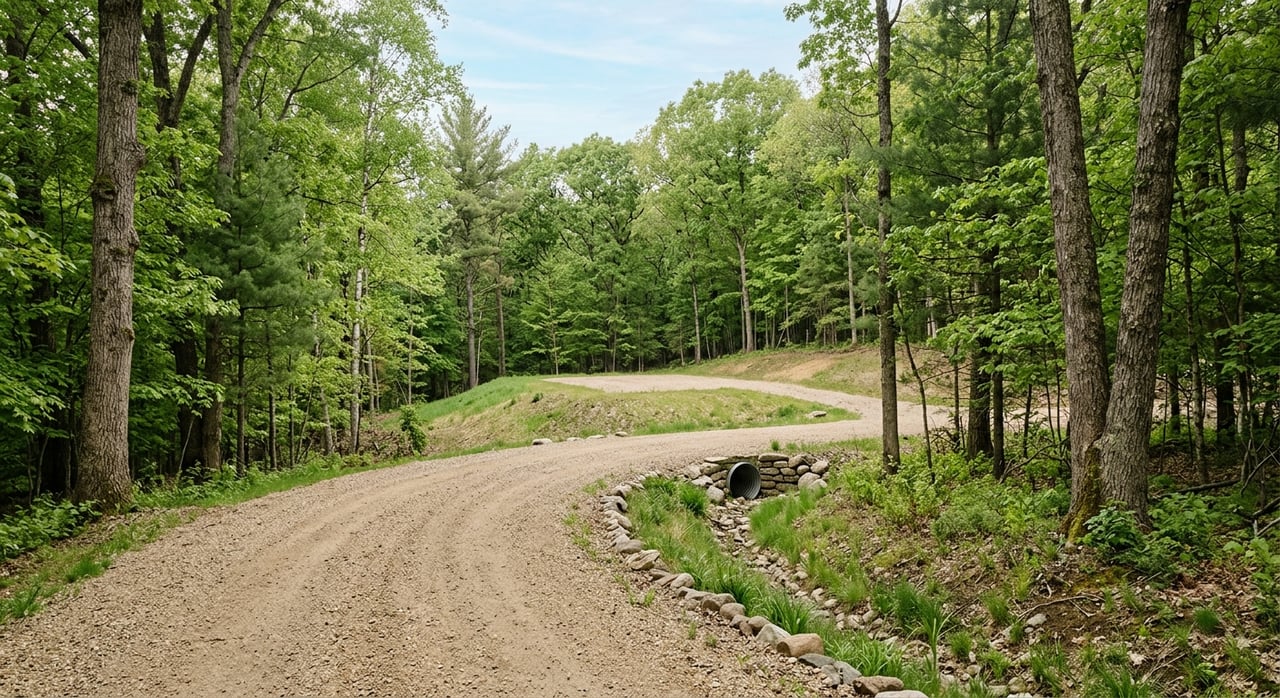
A great-looking tract loses value fast if access is unclear. Before you get too far into a land purchase, make sure the parcel has legal and practical access. You want to know whether the property has road frontage, a recorded easement, or only a paper access route that may be harder to use than it sounds.
If the parcel connects to a state-maintained road, access should be reviewed early with the North Carolina Department of Transportation. NCDOT says a driveway permit is required in many situations involving access to the State Highway System, although permits are normally not required for a single residence. Even so, the owner should contact the District Engineer early, and local approval may also be required.
Questions to ask about access
- Does the parcel have confirmed legal access?
- Is the road state-maintained, private, or shared?
- Is there enough usable frontage for a driveway?
- Will slope or drainage make the driveway costly?
- Are there recorded easements that affect the route?
These details matter because easy access often separates a straightforward land purchase from a much more complicated one.
Verify water and septic options
Utilities are one of the biggest factors in evaluating land near Tryon. The Town of Tryon provides water and sewer service where available, but many properties in Polk County still rely on private wells and septic systems. County health assessment information reported that 46.1% of the county population was served by community water systems as of April 2020, which means a large share of properties depend on private water or other arrangements.
You should never assume utility availability based on a listing description alone. A parcel near town may still need a well and septic, while another tract may have access to public service. That difference can have a big impact on cost and planning.
Use soils as an early screening tool
USDA’s Web Soil Survey is a strong first-pass tool when you want to understand whether soil conditions may affect septic absorption fields, foundations, or other land uses. It is not the final word on whether a parcel will support your exact plans, but it can help you identify possible red flags before spending more money.
In North Carolina, the On-Site Water Protection Branch oversees septic systems and private drinking-water wells with local health departments. For buyers, that means septic and well feasibility should be treated as a core part of due diligence, not an afterthought.
Know whether town or county rules apply
Near Tryon, the rules can change depending on where the parcel sits. Some land falls inside the Town of Tryon limits. Some falls in the town’s extraterritorial jurisdiction, often called the ETJ. Other parcels are in unincorporated Polk County and follow county zoning.
That distinction matters because zoning affects what you may be allowed to do with the property. The Town of Tryon zoning ordinance applies within town limits and the ETJ, while Polk County zoning governs county districts. County districts include categories such as low-density residential, agricultural-residential, family farm, equestrian, commercial, industrial, and mixed-use.
Why jurisdiction matters
Jurisdiction helps answer practical questions like these:
- What type of use is allowed on the parcel?
- Are there setback or density rules that affect building?
- Will the property fall under town review or county review?
- Does the zoning fit your intended use now and later?
If you skip this step, you may compare two tracts as if they are interchangeable when they are not.
Do not rely on GIS alone
Polk County GIS is one of the best first tools for researching a parcel. You can use it for parcel lookup, owner search, address search, and general map review. But the county also warns that GIS data is not a survey and that tax parcel information reflects January 1 of the current year, so recent transfers or subdivisions may not yet appear.
That is why a licensed surveyor matters. A surveyor can confirm boundaries, corner locations, easements, and possible encroachments before you rely on the listed acreage or assume a homesite sits where you think it does.
Bring in the right professionals
When a parcel moves from “interesting” to “serious candidate,” professional review becomes important. For land near Tryon, the key team often includes:
- A licensed surveyor to confirm boundaries and easements
- A North Carolina closing attorney for title review and recording coordination
- Site professionals as needed for access, slope, drainage, or utility questions
This step is especially important with older plats, rural access issues, or recorded restrictions.
Compare land sales the right way
One of the biggest mistakes buyers make is comparing land by acreage alone. In the Tryon area, the better comp set usually matches more than size. It should also reflect similar road access, topography, utility availability, zoning or jurisdiction, and ready-to-build status.
For example, a wooded hillside tract with no utility confirmation may not compare well to a gently sloped parcel with public water nearby and a likely septic area. Even if the acre counts are similar, their real-world value can be very different.
Focus on closed sales, not asking prices
Asking prices can show market direction, but they do not prove value. A better benchmark is recent closed sales of similar tracts in similar conditions. Then you can adjust for differences such as:
- Slope and grading needs
- Driveway access
- Water and septic status
- Clearing costs
- Views
- Restrictions or easements
- Town versus county jurisdiction
This is where a data-driven review really helps. Good land pricing comes from matching the parcel to the right sales, not just finding another listing with a similar acre count.
A practical evaluation sequence
If you want a simple process, start broad and get more detailed as the parcel continues to make sense. That approach can save you time and avoid spending money too early.
A practical buyer sequence near Tryon looks like this:
- Pin the parcel in Polk County GIS.
- Confirm whether it falls under Tryon or Polk County jurisdiction.
- Check legal access and road frontage.
- Screen flood risk, slope, and soils.
- Verify water and septic feasibility.
- Compare recent closed sales with similar site conditions.
- Bring in a surveyor, closing attorney, and any needed site professionals.
That order helps you eliminate weak candidates early and spend more time on parcels that truly fit your goals.
If you are looking at land near Tryon, the smartest move is to treat every tract like its own small project. The best parcel is not always the cheapest or the largest. It is the one that matches your budget, your intended use, and the reality on the ground. If you want a steady, local perspective while sorting through land options in Polk County and nearby markets, reach out to Michael Dassel.
FAQs
What should you check first when evaluating land near Tryon, NC?
- Start by identifying the parcel in GIS, then review topography, access, flood risk, soils, and whether the land appears to have a realistic buildable area.
How important is septic feasibility for Polk County land?
- It is very important because many properties in Polk County rely on private septic systems rather than public sewer, so soil and site conditions can strongly affect whether a parcel works for your plans.
Does a Polk County GIS map confirm land boundaries?
- No. Polk County states that GIS data is not a survey, so you should use a licensed surveyor to confirm boundaries, corners, easements, and encroachments.
How do you know if land near Tryon follows town or county zoning?
- You need to confirm whether the parcel is inside Tryon town limits, in the ETJ, or in unincorporated Polk County, because different zoning ordinances may apply depending on location.
Why are closed sales better than asking prices for land value?
- Closed sales reflect what buyers actually paid for comparable tracts, while asking prices only show what sellers hope to get and may not account for access, slope, utility status, or other site differences.