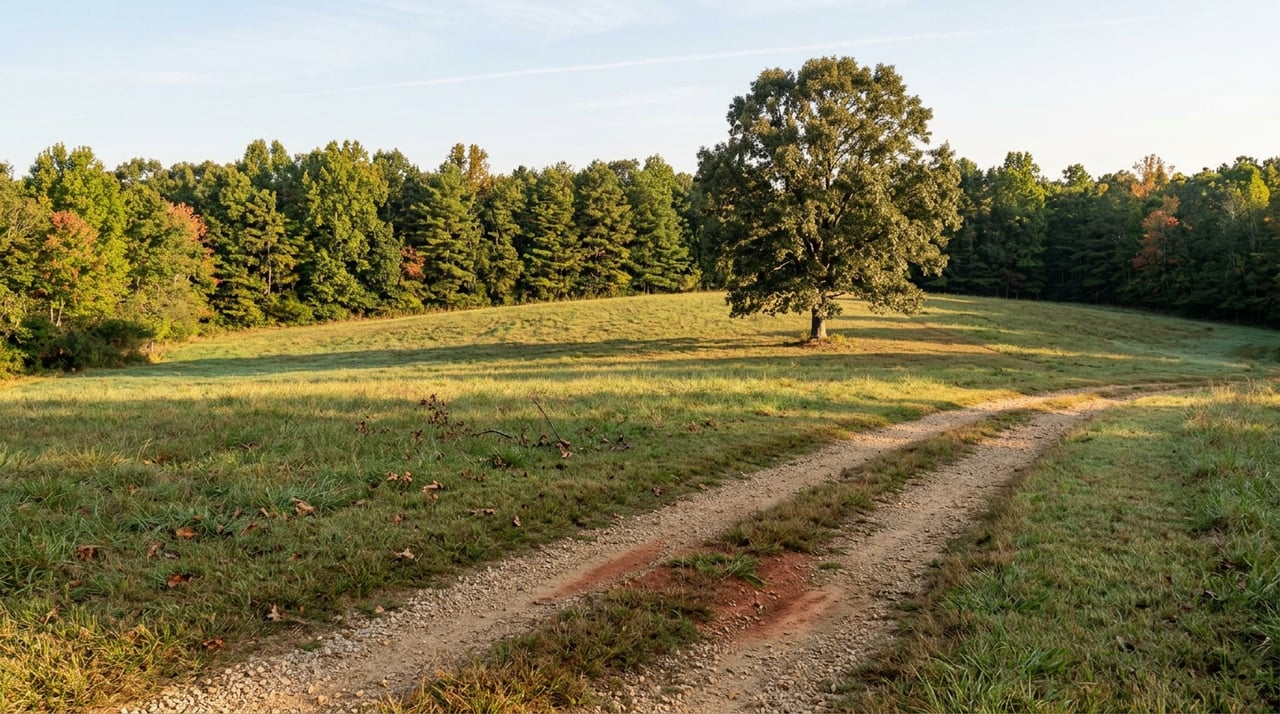
A buyer looking at a wooded parcel off Melvin Hill Road, right where Polk County brushes up against the South Carolina line, sees the same word on nearly every land listing in the area: unrestricted. No HOA. No covenants. Build what you want, when you want. It reads like freedom, and in one sense it is. But unrestricted only answers the question of what a deed allows. It says nothing about whether the ground underneath will actually accept a septic system, and in Polk County that second question has its own paperwork, its own timeline, and its own office you need to call before you sign anything.
That gap between "no deed restrictions" and "confirmed buildable" is where land deals in this corner of western North Carolina tend to stall, and it is the piece of due diligence most out-of-state buyers get backwards.
Unrestricted Doesn't Mean Untested
Scroll through current land listings around Columbus and Tryon and you will see the same phrase again and again: unrestricted, unzoned, bring your own builder. That language describes the absence of a homeowners association or deed covenant, not the presence of a functioning wastewater solution. If the parcel isn't served by public sewer, and most of the acreage in this part of Polk County isn't, the land has to pass a state-mandated soil evaluation before a house, or even a manufactured home, can legally go on it.
North Carolina's rules for this are spelled out in 15A NCAC 18E, the statewide code covering septic permitting from soil evaluation through final inspection. The state overhauled this code effective January 1, 2024, replacing older standards with a single framework that every county environmental health department, including Polk's, now enforces. The practical effect for a buyer: nobody can tell you with certainty that a raw parcel is buildable until a licensed soil scientist or the county's own environmental health staff has been out to look at it.
The Three Permits Nobody Mentions at the Open House
North Carolina requires three sequential approvals before a septic system can legally go into the ground, and skipping any one of them is a code violation that can hold up a sale or force a redesign later.
- Improvement Permit. Issued after a soil evaluation confirms the site can support a system and what type. Good for five years once granted.
- Construction Authorization. Issued after a licensed designer submits a system plan that matches the exact conditions documented in the Improvement Permit.
- Operation Permit. Issued after a county inspector verifies the system was built the way it was approved. For standard systems this permit is permanent.
The Improvement Permit is the one that matters most before you sign a purchase agreement, because it is the document that answers the buildability question. It survives a change in ownership as long as the site and the intended structure stay the same, which means a seller who already secured one can hand it to you. If nobody secured one, that is your job to do before closing, not after.
In Polk County, that process runs through the Polk County Health Center's Environmental Health Unit at 35 Walker Street in Columbus. An applicant needs the parcel identification number, a plat, and a copy of the property survey to get started, and the county's own guidance says to allow one to seven working days once a completed application and soil report are in hand. That fast turnaround is for processing the paperwork itself. Scheduling the soil scientist and getting the report finished is the part that actually eats calendar time, especially if the ground is too wet to evaluate properly, which is common in the wetter months.
The advice worth repeating to anyone shopping raw acreage in this county: get the Improvement Permit before you close, not as a post-closing errand. A few hundred dollars and a few weeks up front is far cheaper than discovering after closing that the flat, pretty building spot you pictured can't support a drain field.
Crossing the State Line Changes the Clock
A fair number of buyers looking at Polk County are also cross-shopping Landrum or Campobello on the South Carolina side, and it is worth knowing the two states don't run this process the same way.
| North Carolina (Polk County) | South Carolina (SCDES) | |
|---|---|---|
| Governing rule | 15A NCAC 18E, recodified 2024 | Regulation 61-56, administered by SCDES |
| Permitting authority | County health department (state sets technical standards) | SCDES regional office serving the county |
| Number of sequential permits | Three (Improvement, Construction Authorization, Operation) | Effectively two (site evaluation and Permit to Construct, then final inspection) |
| Permit fee | Varies by evaluation option chosen | Flat $150 statewide |
| Who can install | Licensed installer required at each stage | Homeowner self-install is legal with proper permits |
| Permit validity | Improvement Permit good for 5 years | Permit to Construct good for 5 years |
South Carolina's Department of Environmental Services, the agency that took over septic permitting from DHEC on July 1, 2024, uses a flatter fee structure and allows a homeowner to install their own system, something North Carolina does not permit. That doesn't make one state's process better than the other. It means a buyer who assumes the timeline they experienced on a Campobello parcel will repeat itself on a Polk County parcel is working from the wrong playbook. Different agency, different fee, different number of stops along the way.
What the Price-Per-Acre Spread Actually Tells You
Current listings across Polk County as of September 2026 show land averaging somewhere in the neighborhood of $40,000 to $49,000 per acre, while the county's overall median sits closer to $23,000 per acre. That gap is not a rounding error. It reflects two different products being sold under one county-wide number.
The higher end of that range tends to cluster around small, cleared homesites close to the Tryon International Equestrian Center corridor, places like White Oak Mountain and the gated communities off US-74, where a two- or three-acre lot with mountain views commands a premium precisely because it's scarce and close to the horse country buyers are drawn to. The lower end of the range is where the large, unrestricted, mostly wooded tracts live, the 30-, 60-, even 200-plus acre parcels along roads like Abrams and Moore or near Green Creek, where per-acre cost drops as total acreage climbs.
This matters for the septic question specifically. On a small, premium homesite, there is very little room to move a drain field if the first spot tested fails. On a large unrestricted tract, there's usually enough ground to shift the target and try again. If you're comparing two parcels by price per acre alone, you're missing the variable that actually determines whether either one is buildable within your timeline.
Before You Write an Offer
A few practical steps make this friction manageable rather than costly.
- Ask the listing agent directly whether an Improvement Permit already exists for the parcel, and if so, request a copy along with the soil evaluation report.
- If no permit exists, build a due diligence period into your offer long enough to complete a soil evaluation, not just a home inspection. Weeks, not days.
- Call the Polk County Health Center's Environmental Health Unit before you tour a property seriously. A five-minute call can tell you whether the parcel has any known soil issues on file.
- If you're comparing a Polk County tract to one across the state line in Spartanburg County towns like Landrum or Campobello, treat the permitting timelines as separate problems with separate agencies, not interchangeable steps.
A Few Questions Worth Asking Directly
Does an existing Improvement Permit guarantee I can build exactly what I want? It confirms the site can support a septic system of a certain type and size, tied to the facility described in the application. If your building plans differ meaningfully from what the permit describes, you may need to revisit the Construction Authorization step even if the Improvement Permit itself is still valid.
What if the land sat unsold for years and the permit expired? North Carolina's Improvement Permit is good for five years. If it has lapsed, you're back to square one on the soil evaluation, which is exactly why it's worth confirming the permit's issue date, not just its existence, before you make an offer.
Is the process any different for a manufactured home instead of site-built construction? The underlying septic requirement is the same either way. If the parcel needs a system and doesn't have public sewer, the Improvement Permit still has to happen first, regardless of what kind of structure eventually goes on the lot.
Land near the Tryon corridor holds its value for good reason, and the paperwork described here isn't a reason to walk away from it. It's a reason to sequence your offer correctly. If you're weighing a parcel in Polk County against something across the state line, or you just want a second set of eyes on a soil evaluation timeline before you write an offer, Michael Dassel works this exact corridor and can walk you through what a specific parcel's permitting history actually says before you're locked into a contract.